

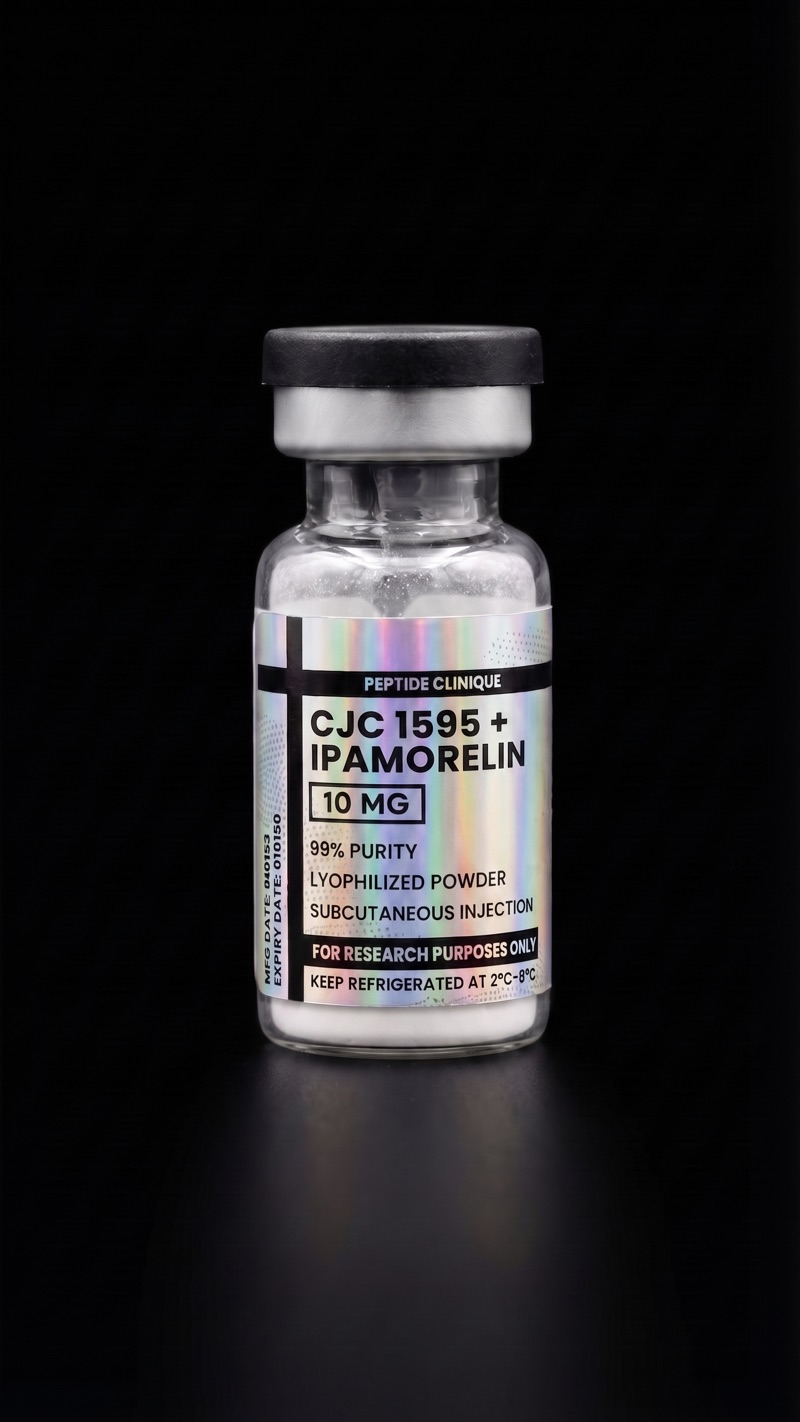
CJC 1295 + Ipamorelin 10mg
$90.00
Laboratory Grade • High Precision Formula • 10mg
What is CJC 1295 + Ipamorelin?
CJC 1295 + Ipamorelin is one of the most powerful peptide combinations in growth hormone research. CJC 1295 is a GHRH analog that stimulates the pituitary to release GH, while Ipamorelin is a selective GHRP that triggers clean GH pulses. Together they work synergistically producing stronger, more sustained GH release than either alone.
Buy CJC 1295 + Ipamorelin in Canada from Peptide Clinique — 99%+ purity, fast domestic shipping.
Key Research Benefits
- Synergistic GH release — stronger combined effect than either alone
- Anti-aging — GH elevation supports cellular repair
- Muscle growth and preservation
- Fat metabolism and lipolysis
- Improved sleep quality
- Recovery acceleration
Product Information
| Purity | 99%+ |
| Form | Lyophilized Powder |
| Administration | Subcutaneous Injection |
| Storage | Keep Refrigerated at 2C-8C |
| MFG Date | 01/01/2026 |
| Expiry Date | 01/01/2030 |
FOR RESEARCH PURPOSES ONLY
Research Background: Growth Hormone Secretagogues and the GHRH/GHRP Axis
Growth hormone (GH) secretion from the anterior pituitary is governed by a complex interplay of stimulating and inhibiting signals. The primary stimulating hormone, growth hormone-releasing hormone (GHRH), is released from the hypothalamus in pulsatile fashion and binds to pituitary receptors to trigger GH release. Simultaneously, growth hormone-releasing peptides (GHRPs) — a separate class of GH secretagogues — work via the ghrelin receptor (GHS-R1a) to amplify GH pulses.
CJC-1295 and Ipamorelin exploit these two distinct mechanisms to produce synergistic GH stimulation. CJC-1295 is a modified GHRH analog designed to extend the half-life of GHRH from minutes to days by incorporating a biotin-aminobutyric acid linker (DAC modification) or optimized amino acid substitutions that prevent degradation by dipeptidyl peptidase IV (DPP-IV). Ipamorelin is a selective, synthetic pentapeptide GHRP that potently stimulates GH release with minimal effect on cortisol and prolactin — providing cleaner GH stimulation than earlier GHRPs like GHRP-2 and GHRP-6.
The scientific rationale for combining these two classes is well-established in endocrinology research: GHRH and GHRPs work through different receptor systems that converge at the pituitary somatotroph. When co-administered, the two classes produce greater GH release than either alone — a synergism documented in multiple preclinical and clinical studies. This combination has become one of the most widely referenced peptide protocols in growth hormone research.
Mechanism of Action: CJC-1295 and Ipamorelin Individually and in Combination
CJC-1295: GHRH Analog Mechanism
CJC-1295 binds to and activates the GHRH receptor (GHRHR) on pituitary somatotrophs. Receptor activation triggers adenylyl cyclase → cAMP → PKA signaling, which: (1) stimulates GH gene transcription; (2) activates voltage-gated calcium channels facilitating GH vesicle exocytosis; and (3) promotes somatotroph cell proliferation over time. The extended half-life of CJC-1295 (via the DAC modification, which allows it to bind albumin) means it can sustain elevated GHRH receptor stimulation for days per injection, creating a blunted but prolonged GH elevation pattern.
Ipamorelin: Ghrelin Receptor Agonism
Ipamorelin activates the GHS-R1a (ghrelin receptor) on both hypothalamic and pituitary cells. At the hypothalamic level, GHS-R1a activation reduces somatostatin (GH inhibitor) release, removing the “brake” on GH secretion. At the pituitary level, it directly amplifies GH release via the phospholipase C → IP3 → calcium signaling pathway. Critically, Ipamorelin has very low affinity for ACTH and prolactin release pathways, making it substantially more selective than earlier GHRPs and reducing potential cortisol-related side effects relevant to research protocol design.
Synergistic Co-administration
The combination of CJC-1295 and Ipamorelin engages both the cAMP/PKA pathway (via CJC-1295/GHRHR) and the PLC/IP3 pathway (via Ipamorelin/GHS-R1a) simultaneously. These pathways converge on calcium-mediated GH vesicle exocytosis, producing GH pulses larger than either compound alone. Research studies have documented 3–10 fold greater GH release with combined administration versus individual compounds in rodent and primate models.
Downstream GH-IGF-1 Axis Effects
GH released in response to CJC-1295/Ipamorelin travels to the liver where it stimulates hepatic IGF-1 production. IGF-1 then mediates many of GH’s downstream effects in research models, including protein synthesis, lipolysis, lean mass accretion, bone density maintenance, and tissue repair acceleration. Researchers use this compound combination to study the full GH-IGF-1 axis under controlled stimulation conditions.
Purity, Quality, and Product Specifications
Peptide Clinique’s CJC-1295 + Ipamorelin blend contains both peptides at research-verified purity levels:
- Composition: CJC-1295 (with DAC) + Ipamorelin combined in a single vial
- Total peptide content: 10mg per vial
- Purity: ≥99% for each component by HPLC analysis
- Form: Lyophilized powder blend
- Testing: Third-party HPLC purity, mass spectrometry identity confirmation for both peptides
- Certificate of Analysis: Available at certificates of analysis
Storage Instructions for CJC-1295 + Ipamorelin
- Lyophilized powder (unopened): Store at -20°C for long-term stability (12–24 months)
- Short-term storage: 2°C–8°C for up to 6 months
- After reconstitution: Refrigerate at 2°C–8°C; use within 28 days
- Avoid: Freeze-thaw cycling of reconstituted solution; light exposure; temperatures above room temperature
Reconstitution Guidelines for CJC-1295 + Ipamorelin
Refer to the dosage guide for complete instructions. Standard reconstitution:
- Reconstitute with sterile Bacteriostatic Water
- Add BW slowly along the vial wall; gently swirl until fully dissolved
- Solution should be clear and colorless after reconstitution
- Common research concentration: 2mL BW per 10mg vial (5mg/mL combined)
- Use U-100 insulin syringes for precise volumetric administration in research models
Related Research Compounds
CJC-1295 + Ipamorelin research fits within a broader context of GH axis and peptide research:
- Ipamorelin 5mg — For researchers studying Ipamorelin independently to understand its standalone GHS-R1a effects, separate from GHRH axis stimulation
- Tesamorelin 5mg — Another GHRH analog with FDA-approved clinical application for HIV-associated lipodystrophy; often compared to CJC-1295 in research exploring GHRH analog pharmacology and abdominal fat reduction mechanisms
See all growth hormone research compounds at our peptide shop.
Who Researches CJC-1295 + Ipamorelin?
- Endocrinology researchers — studying the GH-IGF-1 axis, pituitary biology, and GH secretagogue pharmacology
- Aging and longevity labs — investigating GH decline with age (“somatopause”) and potential GH restoration strategies
- Metabolic researchers — studying GH-mediated lipolysis, body composition changes, and insulin sensitivity
- Muscle biology labs — exploring protein synthesis, anabolism, and recovery in GH-stimulated research models
- Bone biology researchers — studying GH/IGF-1 axis effects on bone density and fracture healing models
Research Applications and Study Design Considerations
CJC-1295 + Ipamorelin research spans multiple study designs depending on the research objective. Short-term acute studies typically examine the immediate GH pulse response over 2–4 hours post-administration, measuring serum GH and IGF-1 by immunoassay. Longer-term chronic dosing studies in rodent and primate models have examined body composition changes, bone density, collagen synthesis rates, and tissue repair metrics over weeks to months of administration.
One important consideration in GH secretagogue research is the pulsatile nature of GH physiology. Unlike continuous GH infusion, peptide-stimulated GH release maintains the natural pulsatile pattern that appears important for downstream receptor sensitivity and IGF-1 responsiveness. Research has examined whether mimicking physiological GH pulses via timed secretagogue administration produces different downstream effects than continuous GH replacement therapy.
Researchers also study inter-individual variability in GH response to CJC-1295 + Ipamorelin. Body mass index, somatostatin tone, and baseline GH status all affect response magnitude. Young healthy subjects with intact somatotrophic function typically show larger GH responses than aged subjects with compromised pituitary reserve — making the compound particularly relevant to models studying age-related GH axis decline.
Frequently Asked Questions
What is CJC-1295 + Ipamorelin?
CJC-1295 + Ipamorelin is a blended growth hormone-releasing peptide. CJC-1295 extends growth hormone release duration while Ipamorelin provides selective GH stimulation without cortisol spikes.
Why buy the blend instead of separate peptides?
The pre-blended format ensures accurate ratios and simplifies research protocols. Both peptides are combined at the correct proportions for convenience.
What purity is this blend?
Our CJC-1295 + Ipamorelin blend is 99%+ purity, third-party tested with COA documentation for each batch.
Reviews
There are no reviews yet.