

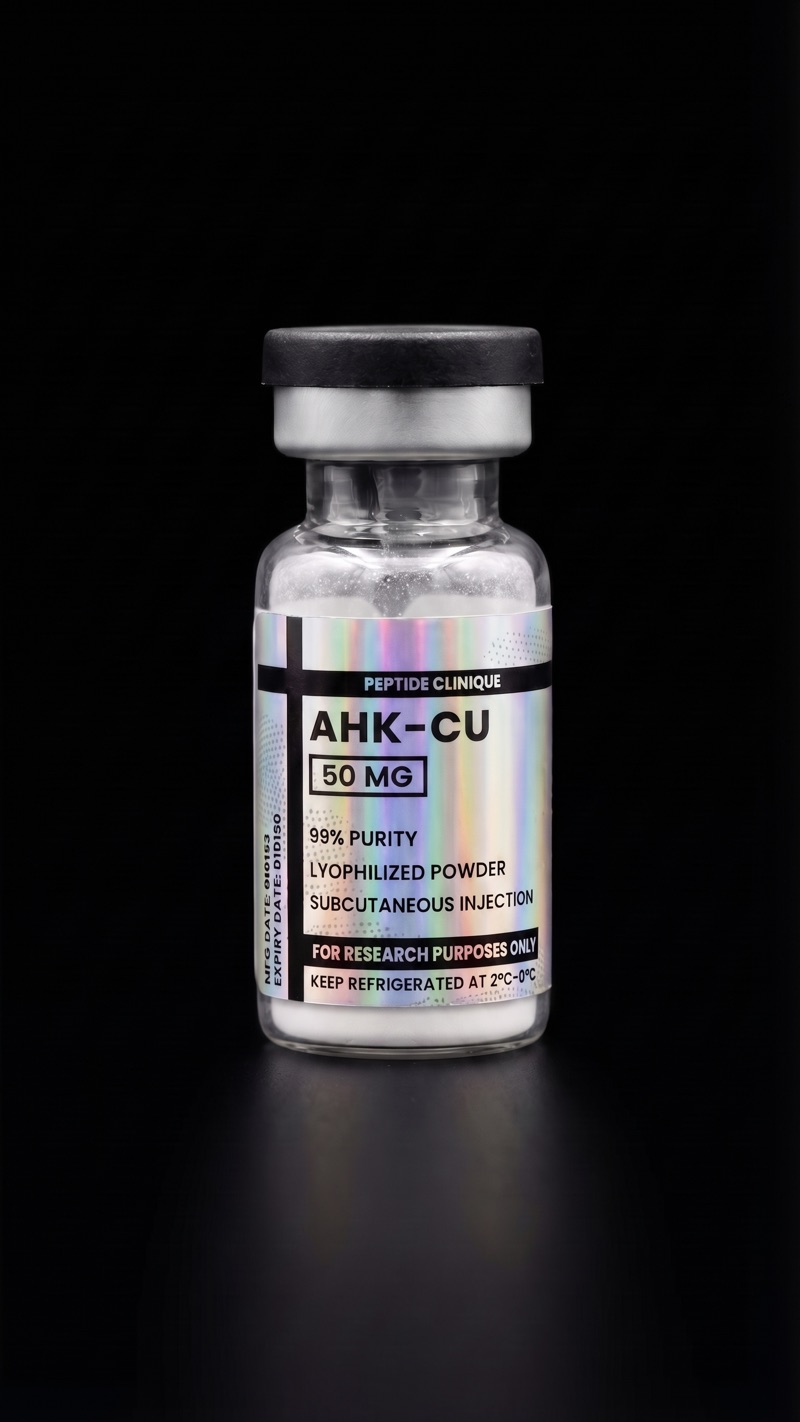
AHK-Cu 50mg
$50.00
Laboratory Grade • High Precision Formula • 50mg
What is AHK-Cu?
AHK-Cu (Alanine-Histidine-Lysine Copper) is a copper-binding peptide tripeptide closely related to GHK-Cu. It is found naturally in human plasma and is recognized for its potent regenerative and anti-aging properties. AHK-Cu has a particularly strong affinity for copper ions, which are essential co-factors in many enzymatic and tissue repair processes.
Buy AHK-Cu in Canada from Peptide Clinique — laboratory-grade, 99%+ purity, with fast domestic shipping.
How Does AHK-Cu Work?
AHK-Cu binds copper and delivers it into cells and tissues where it activates copper-dependent enzymes. These enzymes are critical for collagen synthesis, elastin production, and antioxidant defense. AHK-Cu is studied as a more potent variant of GHK-Cu, with enhanced copper binding capacity and tissue penetration.
Key Research Benefits
- Skin regeneration — stimulates collagen and elastin synthesis
- Anti-aging — studied for reduction of fine lines and skin repair
- Hair follicle stimulation — researched for hair growth and follicle health
- Wound healing — accelerates tissue repair via copper-enzyme activation
- Antioxidant defense — activates superoxide dismutase (SOD)
- Scalp health — studied in models of alopecia and hair thinning
Research Dosage Guidelines
| User Profile | Suggested Research Dose | Frequency |
|---|---|---|
| Topical application | 0.1–1%% solution | Once or twice daily |
| Subcutaneous research | 1–2 mg | Once daily |
Frequently Asked Questions
What is the difference between AHK-Cu and GHK-Cu?
Both are copper peptides, but AHK-Cu has a stronger copper-binding affinity. Research suggests AHK-Cu may be more effective at delivering copper to target tissues, making it a next-generation alternative to GHK-Cu in anti-aging and skin repair research.
Can I buy AHK-Cu in Canada?
Yes. AHK-Cu is available as a research peptide from Peptide Clinique with 99%+ purity and fast domestic delivery.
⚠️ For Research Use Only. Not intended for human consumption. Must be handled by qualified researchers.
Product Information
| Purity | 99%+ |
| Form | Lyophilized Powder |
| Administration | Subcutaneous Injection |
| Storage | Keep Refrigerated at 2°C–8°C |
| MFG Date | 01/01/2026 |
| Expiry Date | 01/01/2030 |
⚠️ FOR RESEARCH PURPOSES ONLY — Not intended for human consumption.
Research Background: Copper Peptides and Tissue Regeneration
Copper peptides are a class of small peptides that form stable complexes with copper ions (Cu²⁺), enabling the delivery of bioavailable copper to specific cellular and tissue environments. Copper is an essential trace element involved in over 30 metalloenzyme systems, including cytochrome c oxidase (mitochondrial respiration), superoxide dismutase (antioxidant defense), lysyl oxidase (connective tissue crosslinking), and dopamine β-hydroxylase (neurotransmitter synthesis). The challenge with copper biology is that copper in free ionic form is highly toxic — copper peptide complexes solve this by delivering copper in a targeted, controlled manner.
AHK-Cu (Ala-His-Lys copper complex) is a tripeptide copper complex closely related to the well-studied GHK-Cu (Gly-His-Lys). While GHK-Cu has accumulated over 40 years of published research, AHK-Cu has emerged more recently as a subject of interest due to its particularly high copper-binding affinity. Research comparing the two peptides has explored whether AHK-Cu’s different amino acid composition confers distinct biological activities or pharmacokinetic properties compared to GHK-Cu.
The plasma tripeptide AHK was first identified in human plasma and noted for its high copper-binding constant. Laboratory studies have since explored AHK-Cu’s effects on fibroblast activity, wound healing models, collagen synthesis, and anti-inflammatory signaling cascades — building a growing evidence base for its role in regenerative medicine research.
Mechanism of Action: How AHK-Cu Influences Cellular Biology
Copper Delivery and Metalloenzyme Support
The primary mechanism of copper peptides, including AHK-Cu, involves the delivery of Cu²⁺ to copper-dependent enzymes. Lysyl oxidase, which requires copper for its activity, is central to the formation and stabilization of collagen and elastin fibers in extracellular matrix (ECM). By supplying bioavailable copper, AHK-Cu may support the enzymatic machinery needed for structural tissue synthesis and remodeling — of particular interest in wound healing and skin aging research.
Antioxidant Enzyme Activation
Copper-zinc superoxide dismutase (Cu/Zn-SOD) is one of the cell’s primary defenses against superoxide radicals. This enzyme is entirely dependent on copper for its catalytic activity. Research with copper peptides has explored whether peptide-delivered copper can enhance SOD activity in tissues where oxidative stress is high. Enhanced SOD function would reduce oxidative burden in aged or damaged tissues.
Wound Healing and Tissue Repair Signaling
In wound healing research models, copper peptides have been shown to activate growth factor signaling pathways, stimulate fibroblast proliferation, and enhance the deposition of new extracellular matrix components. AHK-Cu has been investigated for similar effects. Researchers have examined whether its high copper-binding affinity translates to enhanced fibroblast activation compared to other copper peptide analogs.
Anti-Inflammatory Activity
Copper peptides including GHK-Cu have demonstrated anti-inflammatory activity in preclinical models, in part through modulation of TNF-alpha and other pro-inflammatory cytokines. Research has explored whether AHK-Cu shares these anti-inflammatory properties, which would be relevant to conditions characterized by chronic tissue inflammation and impaired healing.
Purity, Quality, and Product Specifications
Peptide Clinique’s AHK-Cu 50mg meets rigorous research-grade standards with independent third-party verification.
- Full name: Alanine-Histidine-Lysine Copper(II) Acetate
- Purity: ≥99% by HPLC analysis
- Form: Lyophilized powder containing the AHK-Cu complex
- Appearance: Blue-violet powder (characteristic of Cu²⁺ complexes)
- Testing: Third-party HPLC purity, mass spectrometry, elemental copper analysis
- Certificate of Analysis: Available at certificates of analysis
Storage Instructions for AHK-Cu
Copper peptide complexes are generally stable but benefit from careful storage to maintain the Cu²⁺ complex integrity:
- Lyophilized powder (unopened): Store at 2°C–8°C or -20°C for long-term storage
- Light sensitivity: Store in dark conditions; the Cu²⁺ complex can be photosensitive
- After reconstitution: Refrigerate and use within 14–28 days
- Avoid: Strong reducing agents, alkaline pH extremes, and UV light exposure
- Reconstituted appearance: Blue to blue-green colored solution — this is expected for Cu²⁺ complexes
Reconstitution Guidelines for AHK-Cu
See the dosage guide for full protocol. Reconstitution notes:
- Reconstitute with sterile Bacteriostatic Water
- AHK-Cu dissolves readily; a blue-colored solution is expected and normal
- Add bacteriostatic water slowly along the vial wall; gently swirl to dissolve
- Common research concentration: 1–2mL BW per 50mg vial
- Filter-sterilize if adding water from a multi-use vial of BW
Related Research Compounds
AHK-Cu research overlaps significantly with other copper peptide and regenerative biology compounds:
- GHK-Cu 50mg — The most extensively studied copper tripeptide; GHK-Cu and AHK-Cu are often compared in research exploring structure-activity relationships of copper peptides and their relative potencies in skin and tissue remodeling models
- BPC-157 5mg — A body protection compound with distinct regenerative properties; researchers studying tissue repair often investigate BPC-157 alongside copper peptides for potentially complementary mechanisms in wound healing and angiogenesis
Visit our full shop to browse available research compounds.
Who Researches AHK-Cu?
- Dermatology researchers — studying copper peptides for skin aging, wound healing, and collagen synthesis models
- Regenerative medicine labs — exploring tissue repair mechanisms involving copper-dependent enzymes
- Cosmetic science researchers — comparing AHK-Cu to GHK-Cu for structure-activity relationship studies
- Anti-aging biology labs — investigating copper’s role in ECM maintenance and skin structural protein support
- Wound care and surgery researchers — studying copper peptide effects on healing rate, scar remodeling, and tissue regeneration
Frequently Asked Questions
What is AHK-Cu?
AHK-Cu is a copper peptide analog researched for potential anti-aging and skin regeneration properties. It is structurally related to GHK-Cu but with a different amino acid sequence.
How does AHK-Cu differ from GHK-Cu?
Both are copper peptides but AHK-Cu uses a different tripeptide backbone (Ala-His-Lys vs Gly-His-Lys). Research is exploring whether they have complementary mechanisms.
Is COA available for AHK-Cu?
Yes, every batch includes a Certificate of Analysis confirming 99%+ purity from independent third-party testing.
Reviews
There are no reviews yet.