

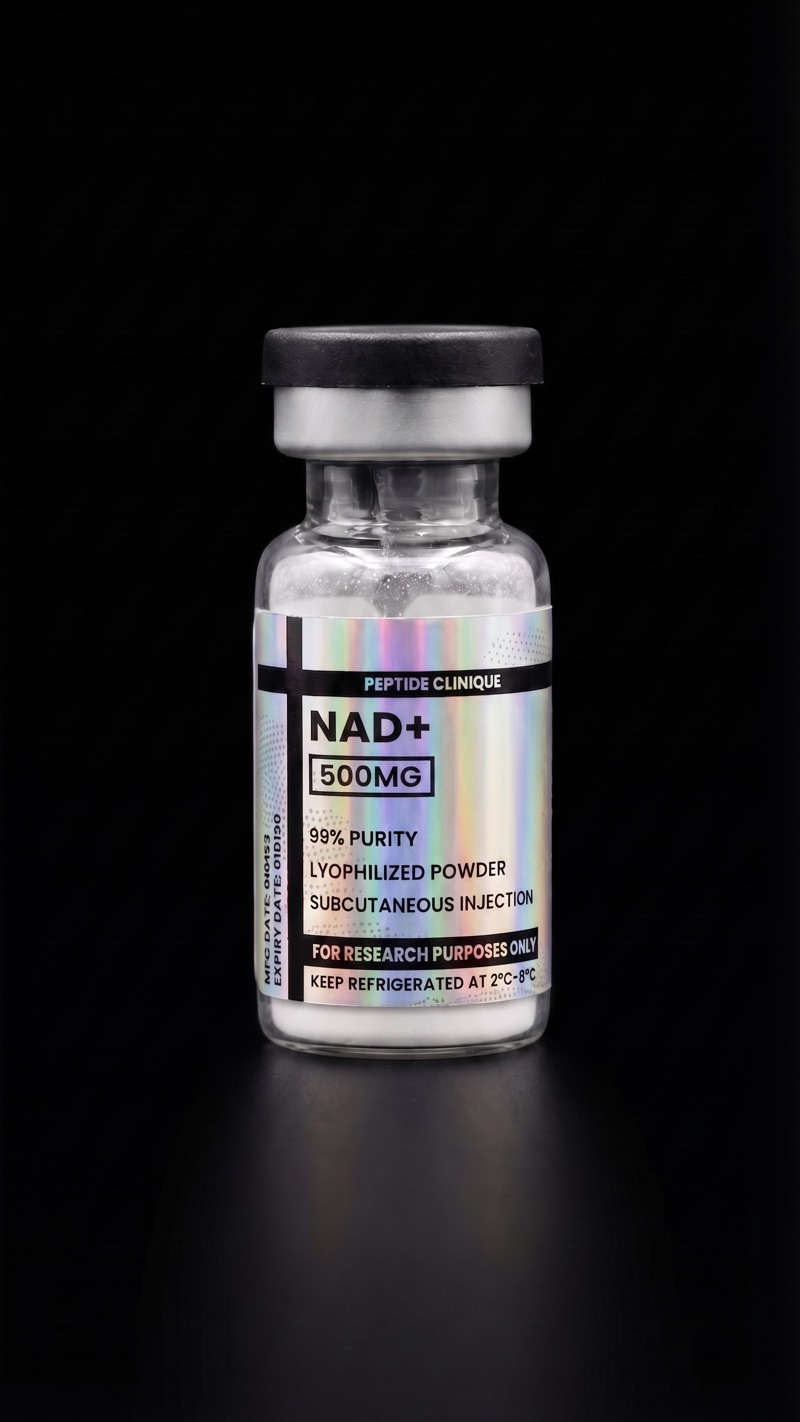
NAD+ 500mg
$85.00
Laboratory Grade • High Precision Formula • 500mg
What is NAD+?
NAD+ (Nicotinamide Adenine Dinucleotide) is a critical coenzyme found in every living cell. It plays a central role in energy metabolism, DNA repair, and cellular signalling. NAD+ levels naturally decline with age — supplementing through research-grade NAD+ has become one of the most studied areas in longevity science.
Peptide Clinique offers laboratory-grade NAD+ in Canada — 99%+ purity, lyophilized powder, with fast domestic shipping.
How Does NAD+ Work?
NAD+ acts as an electron carrier in metabolic reactions, particularly in the mitochondria where it drives ATP (energy) production. It also activates sirtuins — a family of proteins linked to longevity, inflammation control, and DNA repair. Replenishing NAD+ levels supports these core cellular processes.
Key Research Benefits
- Cellular energy production — fuels mitochondrial ATP synthesis
- DNA repair — activates PARP enzymes that repair damaged DNA strands
- Sirtuin activation — linked to anti-aging and longevity pathways
- Neuroprotection — studied for cognitive function and neurodegeneration models
- Metabolic health — supports insulin sensitivity and metabolic efficiency
- Anti-aging — one of the most researched longevity compounds
Research Dosage Guidelines
| User Profile | Suggested Research Dose | Frequency |
|---|---|---|
| Beginner researcher | 250–500 mg | Once daily |
| Intermediate researcher | 500 mg | Once daily |
| Advanced researcher | 500–1000 mg | Once daily |
Frequently Asked Questions
Can I buy NAD+ in Canada?
Yes. Research-grade NAD+ is available from Peptide Clinique in Canada with fast domestic shipping and 99%+ purity verification.
How is NAD+ different from NMN or NR?
NMN and NR are precursors that the body converts to NAD+. Direct NAD+ supplementation bypasses these conversion steps and is studied for more immediate cellular impact.
⚠️ For Research Use Only. Not intended for human consumption. Must be handled by qualified researchers.
Product Information
| Purity | 99%+ |
| Form | Lyophilized Powder |
| Administration | Subcutaneous Injection |
| Storage | Keep Refrigerated at 2°C–8°C |
| MFG Date | 01/01/2026 |
| Expiry Date | 01/01/2030 |
⚠️ FOR RESEARCH PURPOSES ONLY — Not intended for human consumption.
Research Background: NAD+ as a Central Hub of Cellular Metabolism
Nicotinamide adenine dinucleotide (NAD+) is arguably the most important coenzyme in cellular metabolism. Found in every living cell, NAD+ participates in over 500 enzymatic reactions, making it foundational to virtually every aspect of cellular function. It exists in two forms — NAD+ (oxidized) and NADH (reduced) — cycling between states as it ferries electrons through metabolic pathways. The ratio of NAD+/NADH is a critical regulator of cellular energy status.
Research interest in NAD+ supplementation has exploded over the past decade, following landmark discoveries demonstrating that NAD+ levels decline progressively with age. Studies published in prestigious journals including Cell, Nature Medicine, and Science have shown that this decline is functionally linked to hallmarks of aging including mitochondrial dysfunction, genomic instability, impaired DNA repair, and loss of circadian rhythm. Restoring NAD+ levels has been shown in preclinical models to reverse many age-associated functional declines.
Dr. David Sinclair’s laboratory at Harvard Medical School has been at the forefront of NAD+ aging research, publishing seminal work demonstrating that NAD+ repletion via precursors restored muscle function and exercise capacity in aged mice to levels comparable to younger animals. This opened the door to extensive human research that continues today.
Mechanism of Action: How NAD+ Works at the Cellular Level
Mitochondrial Energy Production
NAD+ is indispensable to mitochondrial respiration. In the citric acid cycle and electron transport chain, NAD+ accepts electrons from oxidized metabolic intermediates to form NADH. NADH then donates these electrons to Complex I of the electron transport chain, driving ATP synthesis. Without adequate NAD+, mitochondrial respiration slows, ATP production drops, and cells shift toward less efficient glycolysis — a hallmark of cellular aging and metabolic dysfunction.
Sirtuin Activation (SIRT1-7)
NAD+ is the essential substrate for the sirtuin family of deacylases (SIRT1–7), often called “longevity enzymes.” Sirtuins use NAD+ to remove acetyl and other acyl groups from histones and other proteins, regulating gene expression, DNA repair, and metabolism. SIRT1 and SIRT3 are particularly important for mitochondrial biogenesis and stress resistance. When NAD+ is abundant, sirtuins are active and the cell enters a protective, repair-focused state.
PARP-Mediated DNA Repair
Poly-ADP-ribose polymerases (PARPs) are enzymes that detect DNA strand breaks and initiate repair. PARPs consume NAD+ as their substrate, using it to build poly-ADP-ribose chains that signal the DNA repair machinery. This creates a paradox: DNA damage depletes NAD+, reducing sirtuin activity, which further compromises genomic integrity. Supplementing NAD+ supports the cell’s capacity to repair DNA damage — a mechanism with profound implications for cancer research and aging biology.
CD38 and NAD+ Catabolism
An important but often overlooked aspect of NAD+ biology is its catabolism by CD38, an enzyme that increases significantly with aging and inflammation. CD38 is a highly efficient NADase — it can degrade NAD+ very rapidly. Research suggests that chronic low-grade inflammation (“inflammaging”) drives CD38 upregulation, contributing to the NAD+ decline seen with age. This has prompted research into NAD+ supplementation strategies that can outpace CD38-mediated degradation.
Purity, Quality, and Product Specifications
Peptide Clinique’s NAD+ 500mg is pharmaceutical-grade, manufactured under strict quality controls and independently tested for purity and potency.
- Purity: ≥99% by HPLC analysis
- Form: Lyophilized powder suitable for reconstitution
- Molecular Weight: 663.43 g/mol (as free acid)
- CAS Number: 53-84-9
- Storage stability: Stable for 24+ months when properly stored
- Testing: Third-party HPLC and mass spectrometry verification
View current batch Certificates of Analysis for NAD+ 500mg.
Storage Instructions for NAD+
NAD+ is relatively sensitive to heat, moisture, and light. Proper storage ensures maximum shelf life:
- Lyophilized powder (unopened): Store at -20°C in a sealed container with desiccant
- Short-term storage: 2°C–8°C for up to 3 months; protect from light
- After reconstitution: Use within 24–48 hours; keep refrigerated
- Important: NAD+ in solution degrades relatively rapidly; prepare only what will be used promptly
- Protect from: Direct light (wrap vial in foil), humidity, and temperature fluctuations
Reconstitution Guidelines for NAD+
See the full dosage guide for detailed reconstitution instructions. General protocol:
- Use sterile Bacteriostatic Water for reconstitution
- Reconstitute just before use due to solution instability
- Add bacteriostatic water slowly to the vial — do not shake; gently swirl until dissolved
- NAD+ powder dissolves readily and the solution should be clear to slightly yellow
- Common research dilution: 5mL BW per 500mg vial (100mg/mL)
- Further dilute as needed based on specific research protocols
Related Research Compounds
NAD+ research often intersects with other longevity and cellular health compounds:
- Mot-C 10mg — A mitochondrial-derived peptide that complements NAD+ research by supporting mitochondrial efficiency, AMPK activation, and cellular survival pathways. Both target mitochondrial function from different angles.
- Glutathione 1500mg — The master antioxidant; research explores NAD+ and glutathione co-supplementation to reduce oxidative burden and support cellular redox balance simultaneously.
Explore the full range at our peptide shop.
Who Researches NAD+?
- Aging and longevity researchers — investigating NAD+ depletion as a driver of biological aging
- Metabolic disease specialists — studying NAD+ in the context of obesity, insulin resistance, and NAFLD
- Neurologists — exploring NAD+ neuroprotection in Alzheimer’s, Parkinson’s, and cognitive aging
- Oncology researchers — studying the role of PARP and sirtuins in cancer biology
- Exercise scientists — investigating NAD+’s role in muscle function, fatigue, and recovery
- Circadian rhythm researchers — exploring NAD+’s oscillatory role in maintaining biological clocks
Frequently Asked Questions
What is NAD+?
NAD+ (Nicotinamide Adenine Dinucleotide) is a coenzyme found in all living cells. It is researched for its role in cellular energy production, DNA repair, and aging processes.
Why is NAD+ research popular?
NAD+ levels decline with age. Research suggests supplementation may support cellular repair mechanisms, mitochondrial function, and longevity pathways.
What purity is your NAD+?
Our NAD+ 500mg is 99%+ purity, sourced from cGMP-compliant facilities with independent COA verification.
Be the first to review “NAD+ 500mg”
Related products
Reviews
There are no reviews yet.