

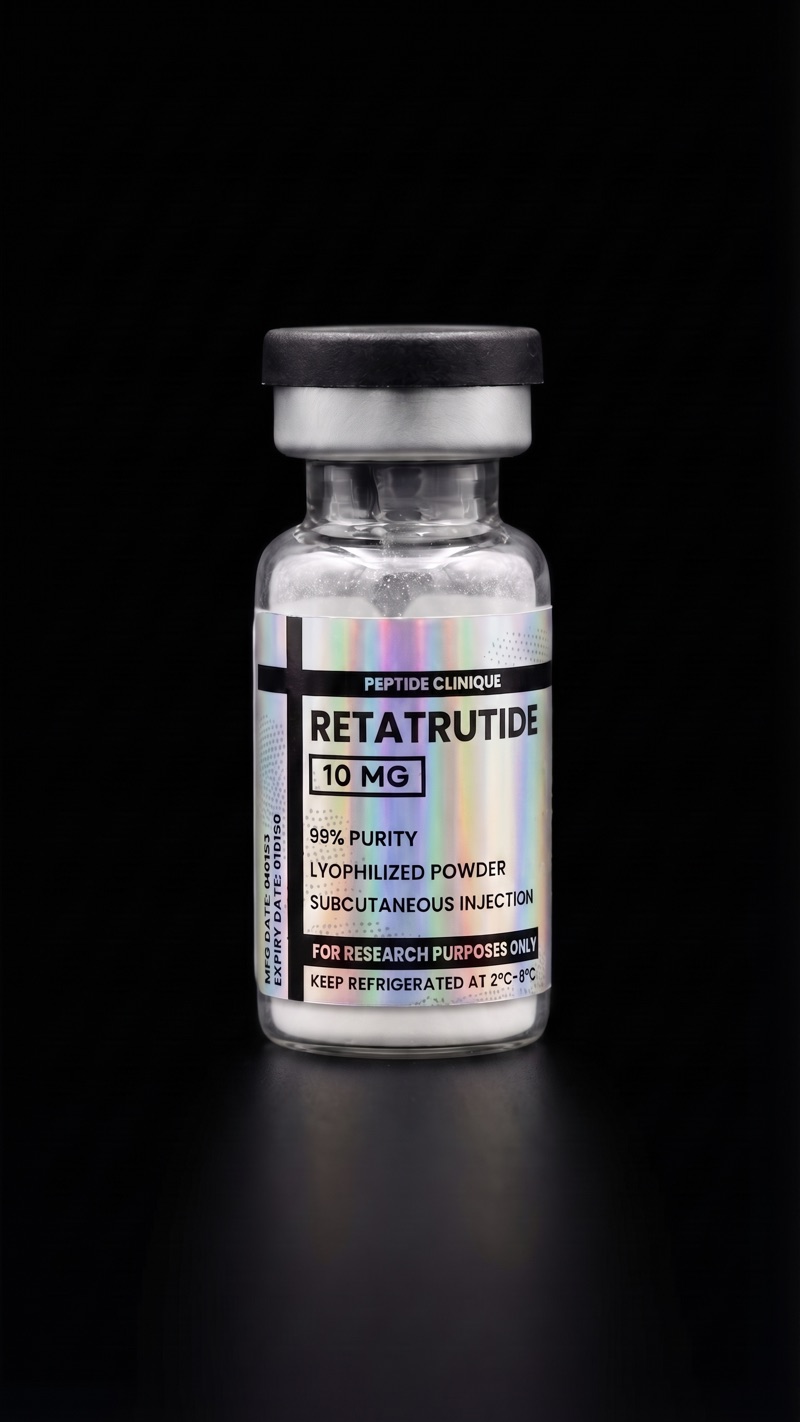
Retatrutide 10mg
$80.00
Laboratory Grade • High Precision Formula • 10mg
What is Retatrutide?
Retatrutide is a next-generation triple receptor agonist peptide, simultaneously targeting GIP (Glucose-Dependent Insulinotropic Peptide), GLP-1 (Glucagon-Like Peptide-1), and Glucagon receptors. This triple-action mechanism makes Retatrutide one of the most powerful metabolic peptides currently under research — and it has rapidly become one of the most talked-about compounds in obesity and metabolic health science.
Buy Retatrutide in Canada from Peptide Clinique — laboratory-grade, 99%+ purity, ISO-certified, with fast domestic shipping.
How Does Retatrutide Work?
Retatrutide’s triple receptor activity creates a synergistic metabolic effect:
- GLP-1 agonism — reduces appetite, slows gastric emptying, improves blood sugar regulation
- GIP agonism — enhances insulin sensitivity and fat storage regulation
- Glucagon agonism — increases energy expenditure and promotes fat burning
This combination produces more significant effects on body weight and metabolic markers than single or dual receptor agonists studied in comparison trials.
Key Research Benefits
- Significant weight reduction — phase 2 trials showed up to 24% body weight reduction
- Appetite suppression — strong reduction in hunger signaling
- Improved blood sugar control — beneficial effects on insulin and glucose
- Fat mass reduction — particularly visceral (abdominal) fat
- Cardiovascular markers — improvements in blood pressure and lipid profiles
- Liver health — studied for non-alcoholic fatty liver disease (NAFLD)
Research Dosage Guidelines
| User Profile | Suggested Research Dose | Frequency |
|---|---|---|
| Beginner / Introductory research | 0.5–1 mg | Once weekly |
| Intermediate researcher | 2–4 mg | Once weekly |
| Advanced metabolic research | 4–8 mg | Once weekly |
| Older adult / metabolic syndrome models (45+) | 1–2 mg | Once weekly — slow titration |
Retatrutide is typically administered once weekly. Start low and titrate slowly to assess response.
Frequently Asked Questions
How is Retatrutide different from Semaglutide or Tirzepatide?
Semaglutide targets one receptor (GLP-1). Tirzepatide targets two (GIP + GLP-1). Retatrutide targets three (GIP + GLP-1 + Glucagon), producing greater energy expenditure and more significant weight loss outcomes in research trials.
Can I buy Retatrutide in Canada?
Yes. Retatrutide is available as a research peptide in Canada from Peptide Clinique, with discreet shipping and 99%+ purity.
⚠️ For Research Use Only. Not intended for human consumption. Must be handled by qualified researchers.
Category: Weight Loss
Often researched with: Ipamorelin | Tesamorelin | Bacteriostatic Water
← View all Weight Loss peptides
Product Information
| Purity | 99%+ |
| Form | Lyophilized Powder |
| Administration | Subcutaneous Injection |
| Storage | Keep Refrigerated at 2°C–8°C |
| MFG Date | 01/01/2026 |
| Expiry Date | 01/01/2030 |
⚠️ FOR RESEARCH PURPOSES ONLY — Not intended for human consumption.
About Retatrutide: A Comprehensive Research Overview
Retatrutide (LY3437943) is a first-in-class triple receptor agonist developed by Eli Lilly and Company, designed to simultaneously activate three key metabolic receptors: the glucagon-like peptide-1 receptor (GLP-1R), the glucose-dependent insulinotropic polypeptide receptor (GIPR), and the glucagon receptor (GCGR). This “triple agonist” profile distinguishes retatrutide from dual-agonist compounds like tirzepatide (GLP-1R/GIPR) and single-agonist drugs like semaglutide (GLP-1R only). By co-engaging all three incretin- and glucagon-axis receptors, retatrutide represents one of the most potent metabolic research tools in the peptide landscape entering 2026.
Our Retatrutide 10mg is supplied as a lyophilised white powder of ≥98% purity, verified by HPLC and mass spectrometry. A third-party Certificate of Analysis is available for every batch.
Research Background and Development History
The development of retatrutide emerges from decades of incretin biology research. The discovery that GLP-1 and GIP amplify insulin secretion in a glucose-dependent manner, first described in the 1980s, laid the groundwork for a generation of therapeutic research. The subsequent identification of glucagon’s role in hepatic glucose output and energy expenditure pointed toward a triple-receptor strategy as potentially superior for addressing the intertwined metabolic derangements characteristic of obesity and type 2 diabetes.
Eli Lilly’s research teams optimised the retatrutide molecule for balanced receptor affinity across all three targets, along with extended half-life through fatty-acid conjugation—enabling once-weekly dosing in clinical trial designs. Phase 1 data published in 2023 documented the compound’s pharmacokinetic and safety profile. Phase 2 results, also published in 2023 in the New England Journal of Medicine, reported unprecedented mean body weight reductions of approximately 17.5% at 24 weeks in participants receiving the highest doses, propelling retatrutide into the spotlight as a potential next-generation metabolic therapy candidate. Phase 3 trials were ongoing as of early 2026.
Mechanism of Action
Retatrutide’s multi-receptor activity produces a synergistic metabolic profile beyond what individual receptor agonism achieves:
GLP-1 Receptor Agonism
Activation of GLP-1R stimulates glucose-dependent insulin secretion from pancreatic beta cells, suppresses glucagon release from alpha cells, slows gastric emptying, and promotes satiety through CNS pathways. These combined effects reduce postprandial glucose excursions and caloric intake. GLP-1R agonism is the shared basis of all approved incretin therapies, from liraglutide to semaglutide.
GIP Receptor Agonism
GIPR activation amplifies glucose-stimulated insulin secretion in concert with GLP-1R. GIP also has direct effects on adipose tissue, influencing fat storage and lipid metabolism. The GIP receptor is also expressed in bone and the brain. Dual GLP-1/GIP agonism (tirzepatide) demonstrated superior efficacy over GLP-1 alone, suggesting that GIPR engagement adds meaningful metabolic benefit independent of GLP-1 pathways.
Glucagon Receptor Agonism
GCGR activation is the element that sets retatrutide apart from dual agonists. Glucagon is classically known as a counter-regulatory hormone that raises blood glucose; however, at the systemic level, glucagon also increases energy expenditure, stimulates hepatic fatty acid oxidation, and promotes lipolysis. When GCGR agonism is combined with GLP-1R activity (which controls insulin secretion to prevent hypoglycaemia), the net result is enhanced fat mobilisation and thermogenesis without undue glycaemic instability. Research models suggest this triple mechanism may explain the particularly dramatic body composition changes observed in clinical trials.
Central Nervous System and Appetite Regulation
All three receptors targeted by retatrutide are expressed in hypothalamic nuclei governing energy homeostasis. Triple agonism therefore produces strong central anorectic signalling, reducing appetite and food-reward drive via multiple convergent pathways—an effect that appears additive or even synergistic compared to dual or single agonism.
Clinical Trial Highlights (Research Context)
The Phase 2 NEJM-published trial (Jastreboff et al., 2023) enrolled adults with BMI ≥27 and evaluated multiple retatrutide doses over 48 weeks. Key data points included:
- ~24% mean body weight reduction at 48 weeks with the 12 mg dose group
- Superior weight reduction compared to semaglutide and tirzepatide historical benchmarks
- Significant reductions in waist circumference, triglycerides, and visceral adiposity markers
- Dose-dependent GI side effects (nausea, vomiting) consistent with incretin-class agents
Phase 3 trials (TRIUMPH programme) launched in 2024 to evaluate long-term safety, cardiovascular outcomes, and efficacy across broader populations.
Purity, Quality, and Analytical Testing
- HPLC Purity: ≥98% — confirms peptide identity and chromatographic purity
- Mass Spectrometry: Confirms molecular weight and sequence fidelity of this complex peptide
- Endotoxin testing (LAL): Verified below accepted research-grade limits
- Sterility: Tested per standard microbiological protocols
Full analytical documentation is available on our Certificates of Analysis page.
Storage Instructions
- Lyophilised: Store at −20 °C (freezer). Stable up to 24 months when kept dry and away from light.
- Reconstituted: Store at 2–8 °C (refrigerator). Use within 28 days. Avoid repeated freeze-thaw cycles.
- Handling: As with all fatty-acid-conjugated peptides, minimise exposure to elevated temperatures and direct sunlight.
Reconstitution Guide
- Allow the vial to reach room temperature before opening (5–10 minutes).
- Wipe the rubber stopper with a 70% isopropyl alcohol swab and allow to dry.
- Inject bacteriostatic water slowly down the side wall of the vial using a sterile syringe.
- Swirl gently until fully dissolved — do not vortex or shake vigorously.
- Inspect for clarity; a clear, colourless solution is expected. Discard if cloudy.
- Label with reconstitution date and calculated concentration.
For concentration calculations and research dosing frameworks, see our Dosage Guide.
Who Researches Retatrutide?
- Metabolic disease researchers studying obesity, insulin resistance, and type 2 diabetes models
- Endocrinology labs investigating incretin receptor signalling and beta-cell function
- Cardiovascular researchers exploring cardiometabolic risk factor reduction
- Hepatology groups studying non-alcoholic fatty liver disease (NAFLD/NASH) and lipid metabolism
- Pharmacology researchers comparing triple vs. dual vs. single receptor agonist profiles
This product is supplied strictly for research purposes only. Not for human consumption.
Related Products
Researchers working on metabolic and growth hormone pathways may also be interested in:
- Tesamorelin 5mg — GHRH analogue studied for GH-mediated effects on visceral adiposity and body composition
- Ipamorelin 10mg — Selective GH secretagogue with low off-target effects; relevant to body composition and metabolic research
Browse the full range at our Shop.
Frequently Asked Questions
What is Retatrutide?
Retatrutide is a triple-agonist peptide targeting GLP-1, GIP, and glucagon receptors simultaneously. It is one of the most researched metabolic peptides in 2026.
Is Retatrutide available in Canada?
Yes, Peptide Clinique offers Retatrutide 10mg for research purposes with fast Canadian shipping and COA documentation.
What purity is your Retatrutide?
Our Retatrutide is 99%+ purity, independently tested and verified with a Certificate of Analysis provided for each batch.
Be the first to review “Retatrutide 10mg”
Related products

Reviews
There are no reviews yet.